Saaspocalypse: Real Or Hype?
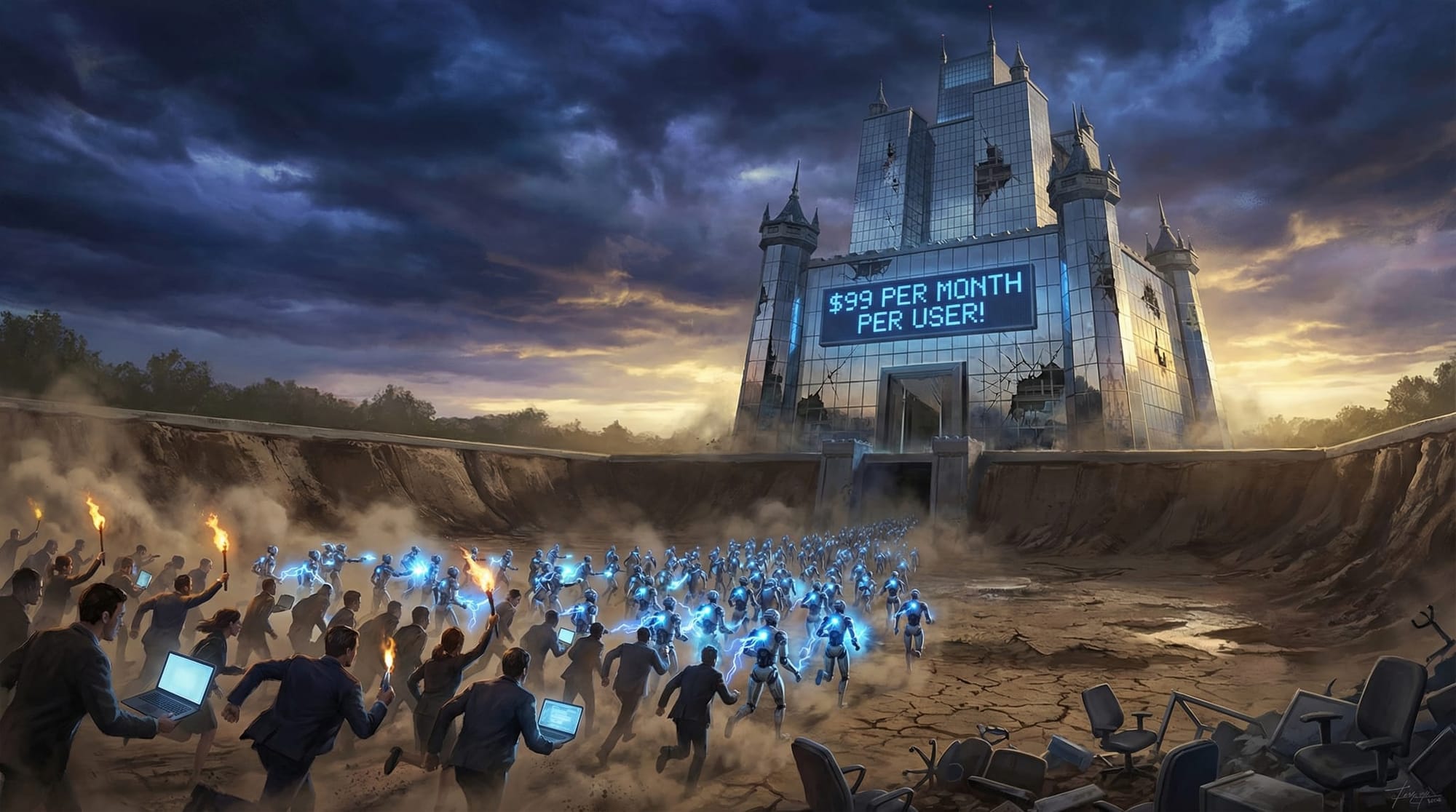
Everyone is talking about a Saaspocalypse - the end of SaaS as AI takes over software development. Is that real or just hype? Here is what I actually think is happening.
In the pre-AI-coding days, reproducing software was hard and expensive. You had to hire a team, raise funding, and then spend months developing, testing, and making product decisions. That friction was a natural barrier to entry. SaaS thrived because building complicated software was a moat.
Because software was so expensive, it made sense for a few companies to invest to make it and then spread their costs across thousands of customers. Customers got software for far less than it would have cost them to build it themselves, and SaaS companies extracted a premium by carrying the cost of development and maintenance. Since most businesses faced similar problems, SaaS companies could build the 80% of common features that almost everyone needed, then layer in the 20% of specialized features that some subset of customers required.
But SaaS has always carried hidden costs. Because it runs on the open web and serves multiple tenants simultaneously, it needs extra security infrastructure to prevent bad actors from infiltrating public servers, and ensure Customer A can’t see Customer B’s records. It also has other complexities of serving multiple customers. Because every customer runs on the same codebase, a SaaS company ends up building the superset of features for all of their customers, not just the ones any single customer will ever use. Finally, supporting thousands of customers simultaneously means engineering for scale that no individual customer would face on their own.
All of that made sense when software development was expensive. In the last 12 months, this has all changed.
With AI, code is getting cheaper and easier to create. Work that used to take a development team six months to ship is now getting built by one person or a small team in a matter of weeks. Companies are waking up to the fact that software that once seemed impossibly expensive to replicate can now be built cheaply, quickly and custom-fit to their actual needs.
The average business uses maybe 30 to 50 percent of what any given SaaS product offers. The rest is features built for other customers, security infrastructure designed for other threat models, scaling headroom they’ll never need. They’ve been subsidizing all of it. AI coding changes that math pretty fast.
There are already plenty of stories floating around about companies replacing expensive SaaS subscriptions with their own custom-built versions.
This shift is starting to look less like a trend and more like a structural change. Which brings up the obvious pushback.
Wait. Isn’t this just AI hype? Aren’t AI tools mostly slop that are not nearly as good as the long-living SaaS products?
At first glance, you’d think established SaaS companies should have nothing to worry about. The AI-coded alternatives showing up today are nowhere near as good. A SaaS company has spent years figuring out the exact UX, the right feature set, the subtle product decisions that keep users engaged and coming back. There are a lot of hidden requirements in mature software, and AI-coded copycats often miss them. Most of these alternatives cover maybe 30 to 50 percent of what the full SaaS product offers. They’re shallow replicas, not complete replacements.
So obviously the SaaS companies survive this, right?... Right?
The real insight is most individual companies only need a small fraction of what a SaaS company offers. A business selling AI voice products has no use for the Salesforce extension built for farmland equipment management or the Epic and medical database integrations. A single development team using Jira for Python code on Google infrastructure doesn’t care about the Microsoft integrations or any Jira plugins for TypeScript or Rust.
A lot of the security infrastructure baked into SaaS becomes irrelevant if your software isn’t publicly accessible. The extra hardening isn’t necessary if your software is behind the corporate firewall. And all the money poured into making that SaaS scalable? It doesn’t really matter either. A small or mid-sized business doesn’t need to worry about engineering their internal tools to scale to hundreds of thousands of concurrent users.
By using SaaS, companies are paying extra for the vendor’s marketing costs, scaling infrastructure, features they’ll never touch, and security designed for a threat model they don’t have. By building their own software, they can cut those costs, add the features the SaaS never prioritized, and customize everything for their specific processes. Running it on their own intranet often makes it safer than having that data sitting in a SaaS company’s increasingly breach-prone infrastructure.
Then there’s the agent question. As we move into an era of AI agents, the interface problem becomes obvious. Agents don’t use polished UIs. They don’t click through forms or navigate dropdown menus. They need proper APIs with direct programmatic access. Legacy SaaS wasn’t built for that. MCP wrappers and stripped-down API layers are missing a lot. Companies are going to want their agents to have direct, full control over the tools they use without needing a human in the loop, and most SaaS products can’t actually deliver that. They were optimized for human use, not agent use. The companies that figure out agent-native interfaces first - real programmatic control, clean APIs, no UI tax - are going to have a significant edge. This isn’t a minor UX problem. It’s an architectural one that may be hard for SaaS vendors to solve - as they have been optimizing for decades for human input.
So is this the end of SaaS?
No, SaaS businesses are not going to die overnight. Think about Yahoo, AOL, Craiglist, Microsoft Office - technologies that everyone wrote-off two decades ago but instead are still viable. Companies are not going to throw out their SaaS relationships tomorrow. So many existing processes are already built around these products that walking away from them is painful and slow.
But change is coming. The traditional SaaS growth engine is going to slow down. Existing customers will likely stick around because switching costs are real, but new customer acquisition is going to get harder. A growing subset of companies that would have previously purchased a SaaS product will just build their own version. Think of a fast-moving AI-first startup that needs a CRM. They can probably build and iterate on something custom faster than they can get Salesforce configured and deployed properly.
Even companies that don’t roll their own will have many more options. Software becoming easier to produce means a Cambrian explosion of cheap copycat products. Dozens of startups will show up in any given niche within weeks of a market being validated, and many will be built by AI-first teams moving at speeds that legacy vendors can’t match. That competitive pressure means pricing power is going to erode. SaaS companies have been steadily raising prices for years, often charging for features and integrations that most of their customers will never use, operating on the assumption that switching costs make customers captive. Once IT departments know they can spin up a serviceable internal alternative in a few weeks, they’re going to push back. Who wants to pay $100k a year for a bug tracker when someone on the team shows they can build a custom one in three weeks? Even if the custom built one is “demoware” that is missing features, it rapidly drives down the price-perception.
What really changes is the future of new SaaS businesses. Any good idea now immediately attracts dozens of competitors. The race to the bottom on price is going to be brutal.
The commoditization of software is coming and will not hit all SaaS equally. I wrote about this previously. SaaS products whose main differentiator is product quality are the most at risk of the Saaspocalypse. It’s too easy for someone to screenshot or screen-record a UI, hand it to Claude Code, and have a working replica within days. Products with sprawling feature sets will take a bit longer, but we’re talking weeks instead of years.
I used to think that companies with lots of integrations or those serving niche markets would survive easily. I’m starting to change my mind. Integrations used to be a real technical lift. Now setting up OAuth is probably the hardest part of the whole process. A developer can just have Claude Code or Codex wire up most integrations in an afternoon. And niche markets are just as exposed, because the customers themselves can now AI-code their own solutions.
The companies most likely to hold on? First, those with strong network effects. Software that gets more valuable as more people or companies use it. LinkedIn isn’t going anywhere because everyone is on it. Slack survives because of cross-company communication. Salesforce will continue as there are just too many companies connected to it. Network effects are a real moat.
Companies that need regulatory approval, full HIPAA compliance, or SOC 2 certification will have more breathing room. Getting those certifications takes time and process even with AI coding. SaaS selling into regulated industries that require these certifications will hold an advantage for longer.
Software that requires very high uptime is also more defensible. A custom-built alternative might run at 99% uptime. For software that cannot go down even for a few minutes, companies will stick with established vendors. This also includes software that is frequently used by the entire company.
The SaaS businesses that survive this are the ones with network effects, regulatory moats, or uptime requirements. Those are real structural advantages.
For the last last 25 years, SaaS companies thrived because building products was an expensive and complicated moat. But that moat is being drained. As software becomes cheaper we will see a slow and steady decline of SaaS and the reinvention of new types of software. While, scary, this constant change is honestly what makes being in the tech space so much fun.